Showing posts with label govenment. Show all posts

Friday, April 1, 2011

From the Mouths of Teens

By the Election of 1860, America was polarized well beyond the sectionalism that had long existed.

Lincoln was a moderate; he was a figure that could potentially serve as a funnel through which two solutions could be poured. The resulting concoction America can only imagine. “For the polarized sides, ideas must be funneled down into ideas on which both sides will agree.” Our leaders must serve as “filters” of extreme ideas, promoting instead ideas of moderating reason.

Before his inauguration in March, South Carolina and six other states had already seceded because “change that appears to favor one side of a polarized nation cannot exist. Although Lincoln believed that slavery was an immoral system based on greed, he did not plan to abolish slavery.” Lincoln did not believe that blacks and whites should share equal footing.

Despite this, “a peaceful bond cannot exist between two sides of a nation when there isn’t a satisfying equilibrium achieved.” Sides were drawn, alternate teams were formed and citizens of one nation began to show an allegiance to their team rather than their nation. When an alternate allegiance and “a stubbornness is initiated, you might as well be preaching to a deaf crowd.”

“A disagreement of two people separated by an ocean will only end if a reasonable man will come to build a bridge. At a time when civil war was about to break, the people had taken sides and lost their willingness to reason and to compromise.”

We value democracy but do we understand democratic leadership? A democracy must be characterized by democratic leadership which values “change that meets somewhere in the middle.”

The moral of the story is that one must “be reasonable in unreasonable situations.”

Wednesday, March 16, 2011

Tactic to Pit Worker Against Worker

A conservative issues advocacy group affiliated with Republican strategist Karl Rove (yes, that Karl Rove) has stuck a whole lot of money into union bashing.  Recently, Rove and his group spent $750,000 on a national television ad depicting unions as liberal-backing bullies.
In this Rove advertisement, union members are storming state capitols in order “to protect a system that pays unionized government workers 42% more than non-union workers.”

Once more, politicians are pitting citizen against citizen in hopes that we take our eye off the ball.  It’s done time and again.

To be clear, union members do earn more than non-union members.  How much more?

According to the Freedom Foundation, a group which supports Governor Walker’s efforts,  found that union members make between 11-12% more.

According  to researchers at the University of Wisconsin-Milwaukee, union members earn 5% more.
Economists Keith Bender and John Heywood  seem to support the 5% figure.

In an article in the Green Bay Press Gazette, non-union worker Jimmy Ryan is quoted as saying, “It’s the fear of people unionizing that keeps us making what we make and working the house we do.”

Meanwhile, the teachers’ union in Slinger reconstructed their deal with the Slinger School District and saved the district $1.35 million.

"This is maybe a model of how things of this nature can be handled," Superintendant Robert Reynolds said. "It's more like we didn't sit across the table from each other; we sat around the table with each other and figured it out."

Superintendent Reynolds said it was a negotiator for the teachers union who reached out to him after reading about his concerns about the effects that state education funding cuts could have on the district, given that it had a four-year teachers contract that would remain unaffected by any changes to collective bargaining or benefit levels.

Those unions sure do sound like bullies.

As politicians do their bidding, Nice-Pak Products, Inc. is relocating its production facility from Green Bay to Indiana. 
  
Is it those nasty unions that caused the loss of jobs?  The high taxes perhaps?  NO!

See previous post “My Fellow Citizens, Let’s Be Careful Out There” for that answer. It’s worth saying over and over, like a mantra “Let’s be careful out there.” Don’t get fooled into thinking it’s you vs. me.

Tuesday, March 15, 2011

My Fellow Citizens, Let's Be Careful Out There

Job programs threatened
Federal cuts would curtail operations of employment, training services

While Republicans contend that curbing government spending ultimately will stimulate job creation, critics say jobs will be lost if the spending bill becomes law. One program that will take a hit is the Workforce Investment Act, which provides funding for employment and job training activities.
Jim Golembeski, executive director of the Bay Area Workforce Development Board, (Among the services provided by Bay Area Workforce Development are computer competency classes, assistance on unemployment insurance issues, aid to workers involved in mass layoffs, retraining for unemployed workers and companies, such as Marinette Marine Corp., which need to upgrade its workers skills in a hurry, and job-skill training for young workers), says he would have to shut down his operation if the cuts are approved.
Spokesmen for Sean Duffy and Reid Ribble say that while the Workforce Investment Act programs mean well, they are among those cited in a recent Government Accountability Office report as examples of government duplication and waste. The report found the government spent $17 billion last year on 45 job training programs that generally do the same thing.
It’s worth noting that 94.7 percent of the dislocated workers Bay Area Workforce Development assists get jobs.
So what’s the problem?  Too many are being trained or too many jobs are being created?  Oh, that’s right, the budget.
“The congressman recognizes there is way too much waste in government, and we are focused on cutting it," a spokesman for Ribble said.
Waste?  Getting people trained and back to work is wasteful?
“The bottom line remains that everyone has to share in the fiscal belt-tightening necessary to bring about full economic recovery,” Ribble’s spokesman stated.
Now, where have I heard that before?  Government workers and Medicaid recipients (Medicaid covers one in three children in the United States, making it the largest insurer of children) have certainly heard that before.
Wisconsin Governor Scott Walker signs tax cut bill into law
Businesses get break for moving into Wisconsin

Companies that relocate to Wisconsin won't have to pay income taxes for two years under a bill signed into law Monday by Gov. Scott Walker.  The measure joins three others Walker has signed in his first month in office that he said will send a message that Wisconsin is more business friendly.
Aid to public schools, the University of Wisconsin System, local governments and Medicaid programs were expected to be big targets for cuts in the Walker budget.
Walker's been focused on spending money through tax cuts. Two tax cuts he's already signed would add about $117 million to the state's budget problem over the next two years.
Today, Walker proposed that the state borrow $75 million to build a museum.  Borrow.  Oh, that’s right, the budget.
I’m privileged to have been befriended by many smart people.  One is an entrepreneur in the Chicago area.  He wrote to me:
Taxes are just one consideration when thinking about where to start / move a business.  You also have to factor in the following depending on type of business:

1.) Proximity to skilled labor force (we use a lot of computer programmers, graphic designers, etc. - there tends to be more talent in larger cities).

2.) Proximity to customer base and potential shipping / transaction costs (a huge consideration for manufacturing companies who have to ship product).

3.) Proximity to suppliers (similar to #2, how can you cost effectively get raw materials).

4.) Relocation costs (hard costs associated with moving, time associated with and ability to replace work force, etc.).

There are many other factors, but these are some key ones.
In the ‘80s, I used to watch “Hill Street Blues”.  My favorite part was when Sgt. Esterhaus would warn, “Hey, let’s be careful out there.”

Sunday, March 13, 2011

What Makes a Fact a Fact?

{Photo Credit - Gannett Wisconsin Media}

I guess if you say something often enough, it becomes fact.

At a February 17th news conference, Governor Walker claimed, “I campaigned on this.”

On February 21st, Walker stated, "The simple matter is I campaigned on this all throughout the election.”

Time and again, throughout this budget battle, Walker has echoed the same, “If anyone didn’t know what’s coming, they’ve been asleep.”

I guess if you say something often enough, it becomes fact.

Yesterday, a CNN reporter challenged a capital protester with “Governor Walker campaigned on this.” 

It’s now fact…I guess.

My ten-year-old son asked the other day, “Dad, are grown-ups allowed to lie?” 
Kids are so cute.

On Walker’s website, http://www.scottwalker.org/, it reads the following in regards to education and families: “School districts are often steered off track by one-size-fits-all mandates that suppress innovation. Once we eliminate outdated and unnecessary rules, schools will have the freedom to set high standards and the ability to meet them…
 We will also create a new class of highly qualified, well-paid teachers who will be given the opportunity to advance in their career…
  I understand that Wisconsin families are struggling to make ends meet.”

Would “outdated and unnecessary rules” refer to collective bargaining? 

Walker’s website continues: “The following set of reforms will help put state government back on the side of the people:
·         Start the state budget at zero.
·         Require the use of generally accepted accounting principles.
·         Strip policy and pork projects from the state budget.
·         End the practice of raiding segregated state funds to pay for other programs.
·         Restore Wisconsin’s reputation for clean and honest government.

 Of course, he did not campaign on this.  It wasn’t until after he was elected (December 7th, 2010 to be exact) did he reveal the details of his plan. 
  "Anything from the decertify all the way through modifications of the current laws in place," Walker said.  "The bottom line is that we are going to look at every legal means we have to try to put that balance more on the side of taxpayers and the people who care about services."
  I will admit, in Walker’s defense, that we’ve “been asleep.”

 During the Tommy Thompson years, 1996-2001, pay freezes for teachers were enacted. (In order to compromise, the unions agreed to the pension and benefits packages that Wisconsin teachers have today).
  Thompson (Republican) targeted teachers' compensation, demonized their union and succeeded in passing revenue caps that limited how much school districts could increase spending, termed a Qualified Economic Offer. 
 (For this reason, less money is spent on children and a greater proportion of allotted money is devoted to deferred compensation packages.)

  Despite these cuts, the state’s debt rose by $1.8 billion during the Thompson years despite the nation-wide economic prosperity of this time and growth in state revenues.  In fact, the state’s structural deficit is often credited to Thompson.   
Thompson then resigned to become a member of President Bush’s cabinet. 

Yes, we should have seen this coming
    - The Thompson era was the proper preface.
 
Yes, we’ve been asleep
    – half of the voting age population participated in the last gubernatorial election.   
  
On Saturday, one hundred thousand people protested at the capitol.

  It certainly looks like people are awake now.

Saturday, March 12, 2011

The American Solution?


Pragmatism doesn’t win elections.
A pragmatic candidate may very well begin answering each question with, “It depends on” or “When considering all of the variables” or some other introductory phrase that does not bend to the impatience of today’s populace. People are inconvenienced by wordy explanations peppered with logic and reason. 
People perceive such logic as a candidate attempting to skirt an issue.

Ideologies win elections.
Ideologies are simple, quick, and easy.  
Ideologies cling to the necessity of a villain – somebody, or something, has to be at blame.
Recently, we’ve seen political ideologies place blame on immigrants, Wall Street tycoons, and big government.
Today, blame is placed on the impoverished.  The public, through its ideological prism, sees the lower class as lazy, incapable, and unskilled - that they are to blame for their own plight and that they should have known better, perhaps long ago during their adolescence, for the career path they had chosen.

It seems blame has now diffused into the middle class.

Nearly seventy years ago, coming out of the Great Depression, Abraham Maslow offered a theory that schools recognize still today. Maslow theorized that that if one were to reach their potential, one would have to overcome a series of challenges before doing so.
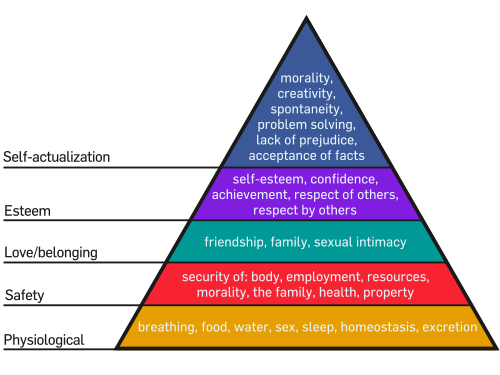
Photo source - Wikipedia
The first of such challenges would to overcome hunger and thirst and to be properly rested.  Over the last year, in the town in which I reside, one out of every three school-aged children participated in the “reduced or free lunch program”.  One out of every three, before they learn their math, science, or reading, must be fed by the school – must be fed with tax dollars.  Sixty-one percent of the children in this country are victims of neglect.

The second such challenge would be for the person to have a sense of security and safety.  In Wisconsin, the percent of married-couple households is 51.6%, the percentage of kids who are read to every day is 46.1%, and, nation-wide, 44% of children are victims of abuse.
Before a young person may discover their potential, as characterized by Maslow’s third and fourth stages, one must have a sense of belonging, friendships, respect of and by others, a sense of achievement and self-esteem.
 
In other words, before a student in today’s culture is ready to learn math, science, or reading skills, a school must expertly nourish, keep safe, and build a child’s sense of belonging to something greater than him/herself.

Sometimes, one potential is not expressed in math or science.  Sometimes, if we’re lucky, one finds their potential in the arts or music.
 
As a teacher, I see many who are choosing impractical career paths such as these. 
I see kids who dream to be artists, actors, musicians, or athletes. 
I see kids who hope to become an art therapist for autistic children.  What a beautiful and perfect expression of one’s potential.
Yet, I feel compelled to shake my head, in obedience to the socioeconomic structure at large, and challenge them: “How will you ever pay the bills!?”    
What a sad expression for what we’ve become.

Disregard FoxNews and MSNBC, advocates of ideology and promoters of villains.
Do not search for a person of pragmatic qualities, become one.
Our children depend on it.

If we must resort to scores on standardized tests, then consider which countries are out-performing the U.S.: Denmark, Iceland, Sweden, Norway, and Finland.
 
In Finland, teaching is a prestigious career. Teachers are highly valued and teaching standards are high. 
Their schools are free from prescriptions based on political ideologies. (See BBC article.)

In Finland, to be competitive, the government has concluded that they must substantially boost investments in education and research in order to foster innovation and cutting-edge development.
(In the town in which I reside, the schools have given the responsibility of working with our most challenging kids - those kids behind in their math and reading and kids with special learning needs - to people making $9/hour.  These paraprofessionals are not master teachers, are not formally schooled in the challenge, and some are not even college educated.  They are people in town who are looking for work and willing to work for that hourly wage.) 

In Finland, the personal income tax structure is more progressive, the capital gains tax is greater, and the corporate tax structure is more demanding. 

Is it socialistic to look toward Finland for answers?
Is it un-American?
Does it violate our sense of national identity?
Only if one were ideological.
We have to find our potential beyond simple ideologies.
We can no longer skirt issues and defy logic.
We have to become pragmatic.

Friday, March 11, 2011

Families Just Looking to Survive

Today, JSOnline reported that 2 out of every 5 children in this state will qualify for subsidized lunch programs. 
  To be eligible for free lunch, a student must come from a family (say a family of four as example) earning $28,655/year or less. 
  Reduced-price lunches are available to students whose families have incomes which amount to $40, 793 for a family of four.

  Statistically, it's reported that the average public school teacher earns $49,000.
  (I have a family of five and for starters will lose $630/month from my family’s income as a result of Governor Walker’s cuts.) 
  After Walker’s cuts and without collective bargaining to help the average worker empower themselves, the average Wisconsin teacher’s kids will qualify for free or reduced lunch.
  Does it appear the families of Wisconsin teachers have too much?

Wisconsin governor defends budget bill as opposition persists 
By the CNN Wire Staff

"The state's Legislative Fiscal Bureau -- similar to the federal government's Congressional Budget Office -- reported last month that tax cuts passed late last year by Wisconsin's newly elected, Republican-led legislature had helped add more than $200 million to the state's budget shortfall."

State Legislature Passes $67M Tax Cut
By WTMJ Radio
Story Updated: Jan 27, 2011
 
 MADISON, Wis. (AP) -- Republican Gov. Scott Walker scored more victories Thursday, signing a major lawsuit reform bill into law and watching as the Legislature approved a tax cut for businesses that he says will create new jobs.
   Walker had promised swift action to show that Wisconsin, in his words, is "open for business." Even though most of his measures have received some support from Democrats, critics argue they are largely symbolic and will do little to actually create jobs or improve the state's economy.
   Senate Democrats said the latest tax cut measure, expected to cost the state $67 million over two years, was too expensive given the projected $3 billion shortfall in the two-year budget. They also said the tax bill, which would give businesses deductions worth $92 to $316 per job, wouldn't be enough by itself to get businesses to hire more people.
   That bill is the third tax cut the Legislature has passed this month. Walker has already signed into law a measure that eliminates income taxes on contributions made to health savings accounts. Another bill awaiting his signature would eliminate corporate and personal income taxes on companies that relocate to Wisconsin.

  The average worker in the private sector is not faring much better.  Yes, today’s average worker has it tough.
  In the state of Wisconsin, a single person making just over $20,000 pays 6.5% in income tax.  A single person making over $150,000 pays 6.75% of his income to the state in the form of income tax. 
  Does that seem fair to anyone?  
  A married couple in the state of Wisconsin making just under $27,000 pays income tax at a rate of 6.5%.  If this married couple has three children, this figure is just $2,000 over the poverty level.  A married couple making over $201,000 pays state income tax at a 6.75% clip. 
  Does that seem fair?
  Today’s battle in Wisconsin is not about unions per se – it’s about fairness – it’s about families struggling to survive.

Thursday, March 10, 2011

Harmony for Families

Weeks ago, union leaders wrote me this:
"On Friday, state and local public employees offered to accept all economic concessions called for in the budget repair bill – including Governor Walker’s pension and health care concessions that he says are needed to solve the state budget challenge.
Governor Walker turned it down.  He wants more."

Walker got what he wanted last night. [Read Here]
 Admittedly, public employees have not always made the most favorable impressions.
A story came out of Milwaukee this summer reporting that their teacher union leaders wanted Viagra to be covered under their insurance plan. [Here]

Disappointing for sure.  In many respects, union leadership and some teachers, as exemplified in this case, have proven themselves unworthy for leadership positions. 
  
This lack of leadership has been obvious on both sides.  

Republicans devised a plan to get around the impasse and hurriedly approved the bill late in the day after meeting for hours behind closed doors.” – JSOnline.com

This plan may have been legal but it certainly was not democratic.  Few would argue that it portrays the lack of political leadership show by the state’s chief executive.

As for my family and our resulting sacrifices, the financial concessions we’ll make will equate to $630/month out of pocket.  However, the financial costs will be so much more when all other contractual variables are considered.

To ask anyone of already moderate income to drop this sum from their family's monthly income is completely unreasonable and potentially economically devastating for us.
For families such as mine, and for so many others, we simply can't budget for those losses.

These personal losses are just a drop in the state’s economic bucket.  My family’s purchasing power was already comparatively minimal.  However, when one considers the impact of the decreased purchasing power accrued by the hundreds of thousands of families of state employees…it may devastate local economies and the economy state-wide.

Those in the private sector, who have so much scorn for the public employee, may find solace in our legislated miseries but that comfort won’t last long. 

Though my family’s contributions to this economy may amount to only one drop, the economy will have to endure the loss of hundreds of thousands of such drops.  Those in the private sector will soon learn that it’s difficult to fill an economic trough when so many drops are absent.  Indicators show the state will lose trillions of dollars worth of purchasing power from its economy.  

Whether or not this state’s economy can endure the loss of so much purchasing power,   I can promise this:  Those of us in the public sector will not find comfort in your losses, will not find refuge in some distorted sense of revenge, and will not celebrate your destruction with commentary.

Reasonable people are everywhere.  Empathetic and hard-working people abound.   

It’s the extremism, absolutism, and authoritarianism in leadership that concerns me.

I tell my students this, “Balance the needs of the individual with those of the greater good.”  If our state leaders put into practice this simple creed, union members, Republicans, teachers and taxpayers would find reasonable solutions for bringing harmony to our families.