Showing posts with label education. Show all posts

Friday, April 8, 2011

Fitting In

It seems to be one high-stakes drama after another. Extreme dissension defines the day in that we pretend that our black-and-white ethics and standards would apply and appeal to all.
Reason has become a sapling amongst a forest of political agendas. Without the strength of reason, that tree that marks the center of the forest, the populace is lost.

From that tree of reason, People run free. Trees of the ideological species have grown such a canopy, however, that People are losing their footing on the dimly lit ground.

People want to feel empowered again.

In schools, students want to feel equally empowered – empowered with choice, opportunity for growth, cohesion, caring, belonging, and control.

People can no longer, particularly today, feel like they are being operated on. People must know that they are the operators.

America is now the macrocosm of schools.

The political culture has become a non-democratic, negative culture.

A negative culture robs us of our reason, rationality, long-term interests, and sense of well-being. We People have lived in communities, learning to get along, establishing rules for behavior, and meeting the expectations of these rules in order to survive and thrive. People inherently have the capability of creating positive culture because of the quest for survival, a quest which has lasted for millions of years. Fitting in with a group and promoting its success is a basic human drive. If it’s ones perception he belongs to a group, he will promote the well-being of that group. If, however, one feels outside of the group, that he doesn’t belong, can’t contribute, and is without influence, that person will not only mistrust those around him but will work toward their destruction. More so, that person will work to create an opposing culture, recruiting peers who also sense that they do not belong.

Welcome to America.

Welcome to our schools.

Schools must become a microcosm of America. Schools may empower students, offer them opportunities for control and influence, and breed positive culture. Schools connect members to one another, constructing community and belongingness. Schools are a springboard into our democracy. Schools are trees of reason, the center of the forest, and not a sampling but a redwood.

Watch closely our schools.

Listen to what’s happening.

Know that our democracy will return as students springboard into recreating our culture.

Tuesday, March 29, 2011

Wisconsin's Water Cooler

Once we’ve drafted our NCAA bracket winners, it doesn’t matter how, we want our teams to advance.  Maybe we can win our $5 pool at our place of work.

Once in Cleveland, we’ll wear dog masks to Browns games, sit in the dawg pound, and bark at the opposition.  And, once in Oakland, we’ll paint our faces to demonize our game personas…anything to win.

Once we’ve chosen a side, “just win baby” – right Al Davis?

Problem is that the Browns and Raiders stink.  Problem is hardly anyone on this planet picked the Final Four.

We’ve chosen our side, now what?

In Wisconsin, we’ve chosen our sides as well.

This week it was reported that Governor Walker decided he doesn’t want to wait for the courts.  He wants his budget money now.  So, he’s taking it now. 

In response to the news story, over 1644 comment were made representing their side…comments which used words like “knuckleheads”, “peons” and “union thugs”.

This morning, it was reported that schools in Milwaukee’s school choice program performed worse than Milwaukee’s public schools in reading and math scores.


Public response included words like “your side”, “greedy”…comment accusing teachers, others blaming Republicans.

It was also reported that over the last six years, scores on statewide reading and math tests have increased and the achievement gap between minority groups and white students has narrowed.

Public response?  “dead beat teachers”…etc.

Here’s the thing: We’ve painted our faces to demonize our public personas and, in truth, our team stinks.  We’ve put on our dawg pound masks.  And, we’ve begun cheering against our co-workers in our office pools in hopes of making pocket change or bragging rights at the water cooler.

We’ve become these people – people who have enclosed themselves in their ideological boxes to such a degree that we know longer can appreciate the game that needs to be played.  The integrity of the game is sacrificed because of our desire to come out on top.  In the end, once the integrity of the game is gone, the game will go with it. 

We don’t need to look much further than the NFL today, stuck in a battle which has brought an end to the game.  I can only imagine that football as we love it will resume once we step out of our boxes, clean off our faces, and begin to participate in the process as fans should. 

Read the Simpson-Bowles budget report.  Find an impartial site and read their suggestions. 

What you’ll find is that the Simpson-Bowles commission suggests for us to 1) reduce defense spending; 2) reduce the size of government and the federal workforce; 3) pay a .15 cent/gallon tax hike on gasoline and restricting home mortgage tax deductions; 4) maintain Medicare costs; 5) reduce entitlements like farm subsidies, government pensions, and student loan subsidies; 6) increase social security payroll taxes and increase the retirement age. 

At the federal level, projections show close to $4 trillion in debt reduction. 

Consider, as we look to pay our debt and grow our economy, the federal government spends $4 on elderly people for every $1 it spends on those under 18. 

Our country can’t afford to reduce funds for education, science research and infrastructure projects if it looks to grow our economy in the long-term.  The Simpson-Bowles report is non-partisan and more worthy of our consideration.

Wisconsin’s solutions are equally accessible.  Let’s step outside of our boxes and find them.

Thursday, March 17, 2011

Swim School


  Can a young boy learn how to swim by oaring him out to the middle of the lake and throwing him overboard?  Sure.
  Far more will drown, however, than learn to swim.

  One might argue for the “life lessons” a young person may learn when employing such a method of teaching.  One might argue the virtues of “Social Darwinism” and contend that the weak should be allowed to merely die off – that somehow weak tend to make their society weak.  Or one might argue that one’s responsibilities begin and end with themselves, alone.

  I would differ in that opinion.  

  In my classroom, each class is composed of teams of students.  Each student belongs to a team and serves as a teammate to a fellow student.
  When a student is absent due to illness or any other unwelcome event, on returning to the classroom, that student has a network of support waiting.  Teammates take the time to explain missed assignments, teach essential learning points, and familiarize the once-absent student with key aspects of the missed lessons.  In other words, teammates offer a network of support. 

  Churches do the same.  A good church will help the citizens of a community form a team, a network of support, which allows teammates to support one another.

  Government, local, state, or national, was formed to do the same.  The responsibility of government is to create a sense of responsibility not to it but to one another, like that of teammates. 

  A friend sent me this today:

His name was Fleming, and he was a poor Scottish farmer. One day, while trying to make a living for his family, he heard a cry for help coming from a nearby bog. He dropped his tools and ran to the bog.

There, mired to his waist in black muck, was a terrified boy, screaming and struggling to free himself. Farmer Fleming saved the lad from what could have been a slow and terrifying death.

The next day, a fancy carriage pulled up to the Scotsman's sparse surroundings. An elegantly dressed nobleman stepped out and introduced himself as the father of the boy Farmer Fleming had saved.

'I want to repay you,' said the nobleman. 'You saved my son's life.'

'No, I can't accept payment for what I did,' the Scottish farmer replied waving off the offer. At that moment, the farmer's own son came to the door of the family hovel.

'Is that your son?' the nobleman asked.

'Yes,' the farmer replied proudly.

'I'll make you a deal. Let me provide him with the level of education my own son will enjoy If the lad is anything like his father, he'll no doubt grow to  be a man we both will be proud of.' And that he did.

Farmer Fleming's son attended the  very best schools and in time, graduated from  St. Mary's Hospital Medical School in London,  and went on to become known throughout the world  as the noted Sir Alexander Fleming, the  discoverer of  Penicillin.

Years afterward, the same nobleman's son who was saved from the  bog was stricken with pneumonia.

What saved his life this time? Penicillin.

The name of the nobleman? Lord Randolph Churchill... His son's name?

Sir Winston  Churchill.

Someone once said: What  goes around comes around.

  Our students are reading Sophocles’ Antigone.

  In Antigone, the heroin acts according to her faith, her values, her sense of humanity, and serves those around her in an effort for the “greater good”. 
ISMENE:  You’re very cheerful.
ANTIGONE: That is because I’m helping those I know that I should help.

  Our students learn Lawrence Kohlberg’s Theory of Moral Development.
  The most basic, rudimentary, primitive and animalistic reason for doing what is right is to avoid punishment.  Next, to gain reward.  Next, to conform. 
  However, as one elevates the reasoning behind their behavior, one will do what is right because it is the right thing to do…
…doing what is right for the right reasons. 

  That is legal.
  That is spiritual.
  That is scholastic.

  There is educational argument for throwing anyone overboard.
 
  Schools create swimmers. 
  Schools create teammates… 
  And give students an opportunity to display their courage.


Sunday, March 13, 2011

What Makes a Fact a Fact?

{Photo Credit - Gannett Wisconsin Media}

I guess if you say something often enough, it becomes fact.

At a February 17th news conference, Governor Walker claimed, “I campaigned on this.”

On February 21st, Walker stated, "The simple matter is I campaigned on this all throughout the election.”

Time and again, throughout this budget battle, Walker has echoed the same, “If anyone didn’t know what’s coming, they’ve been asleep.”

I guess if you say something often enough, it becomes fact.

Yesterday, a CNN reporter challenged a capital protester with “Governor Walker campaigned on this.” 

It’s now fact…I guess.

My ten-year-old son asked the other day, “Dad, are grown-ups allowed to lie?” 
Kids are so cute.

On Walker’s website, http://www.scottwalker.org/, it reads the following in regards to education and families: “School districts are often steered off track by one-size-fits-all mandates that suppress innovation. Once we eliminate outdated and unnecessary rules, schools will have the freedom to set high standards and the ability to meet them…
 We will also create a new class of highly qualified, well-paid teachers who will be given the opportunity to advance in their career…
  I understand that Wisconsin families are struggling to make ends meet.”

Would “outdated and unnecessary rules” refer to collective bargaining? 

Walker’s website continues: “The following set of reforms will help put state government back on the side of the people:
·         Start the state budget at zero.
·         Require the use of generally accepted accounting principles.
·         Strip policy and pork projects from the state budget.
·         End the practice of raiding segregated state funds to pay for other programs.
·         Restore Wisconsin’s reputation for clean and honest government.

 Of course, he did not campaign on this.  It wasn’t until after he was elected (December 7th, 2010 to be exact) did he reveal the details of his plan. 
  "Anything from the decertify all the way through modifications of the current laws in place," Walker said.  "The bottom line is that we are going to look at every legal means we have to try to put that balance more on the side of taxpayers and the people who care about services."
  I will admit, in Walker’s defense, that we’ve “been asleep.”

 During the Tommy Thompson years, 1996-2001, pay freezes for teachers were enacted. (In order to compromise, the unions agreed to the pension and benefits packages that Wisconsin teachers have today).
  Thompson (Republican) targeted teachers' compensation, demonized their union and succeeded in passing revenue caps that limited how much school districts could increase spending, termed a Qualified Economic Offer. 
 (For this reason, less money is spent on children and a greater proportion of allotted money is devoted to deferred compensation packages.)

  Despite these cuts, the state’s debt rose by $1.8 billion during the Thompson years despite the nation-wide economic prosperity of this time and growth in state revenues.  In fact, the state’s structural deficit is often credited to Thompson.   
Thompson then resigned to become a member of President Bush’s cabinet. 

Yes, we should have seen this coming
    - The Thompson era was the proper preface.
 
Yes, we’ve been asleep
    – half of the voting age population participated in the last gubernatorial election.   
  
On Saturday, one hundred thousand people protested at the capitol.

  It certainly looks like people are awake now.

Saturday, March 12, 2011

The American Solution?


Pragmatism doesn’t win elections.
A pragmatic candidate may very well begin answering each question with, “It depends on” or “When considering all of the variables” or some other introductory phrase that does not bend to the impatience of today’s populace. People are inconvenienced by wordy explanations peppered with logic and reason. 
People perceive such logic as a candidate attempting to skirt an issue.

Ideologies win elections.
Ideologies are simple, quick, and easy.  
Ideologies cling to the necessity of a villain – somebody, or something, has to be at blame.
Recently, we’ve seen political ideologies place blame on immigrants, Wall Street tycoons, and big government.
Today, blame is placed on the impoverished.  The public, through its ideological prism, sees the lower class as lazy, incapable, and unskilled - that they are to blame for their own plight and that they should have known better, perhaps long ago during their adolescence, for the career path they had chosen.

It seems blame has now diffused into the middle class.

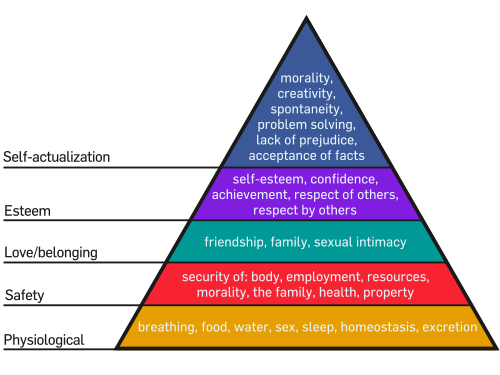
Nearly seventy years ago, coming out of the Great Depression, Abraham Maslow offered a theory that schools recognize still today. Maslow theorized that that if one were to reach their potential, one would have to overcome a series of challenges before doing so.

Photo source - Wikipedia
The first of such challenges would to overcome hunger and thirst and to be properly rested.  Over the last year, in the town in which I reside, one out of every three school-aged children participated in the “reduced or free lunch program”.  One out of every three, before they learn their math, science, or reading, must be fed by the school – must be fed with tax dollars.  Sixty-one percent of the children in this country are victims of neglect.

The second such challenge would be for the person to have a sense of security and safety.  In Wisconsin, the percent of married-couple households is 51.6%, the percentage of kids who are read to every day is 46.1%, and, nation-wide, 44% of children are victims of abuse.
Before a young person may discover their potential, as characterized by Maslow’s third and fourth stages, one must have a sense of belonging, friendships, respect of and by others, a sense of achievement and self-esteem.
 
In other words, before a student in today’s culture is ready to learn math, science, or reading skills, a school must expertly nourish, keep safe, and build a child’s sense of belonging to something greater than him/herself.

Sometimes, one potential is not expressed in math or science.  Sometimes, if we’re lucky, one finds their potential in the arts or music.
 
As a teacher, I see many who are choosing impractical career paths such as these. 
I see kids who dream to be artists, actors, musicians, or athletes. 
I see kids who hope to become an art therapist for autistic children.  What a beautiful and perfect expression of one’s potential.
Yet, I feel compelled to shake my head, in obedience to the socioeconomic structure at large, and challenge them: “How will you ever pay the bills!?”    
What a sad expression for what we’ve become.

Disregard FoxNews and MSNBC, advocates of ideology and promoters of villains.
Do not search for a person of pragmatic qualities, become one.
Our children depend on it.

If we must resort to scores on standardized tests, then consider which countries are out-performing the U.S.: Denmark, Iceland, Sweden, Norway, and Finland.
 
In Finland, teaching is a prestigious career. Teachers are highly valued and teaching standards are high. 
Their schools are free from prescriptions based on political ideologies. (See BBC article.)

In Finland, to be competitive, the government has concluded that they must substantially boost investments in education and research in order to foster innovation and cutting-edge development.
(In the town in which I reside, the schools have given the responsibility of working with our most challenging kids - those kids behind in their math and reading and kids with special learning needs - to people making $9/hour.  These paraprofessionals are not master teachers, are not formally schooled in the challenge, and some are not even college educated.  They are people in town who are looking for work and willing to work for that hourly wage.) 

In Finland, the personal income tax structure is more progressive, the capital gains tax is greater, and the corporate tax structure is more demanding. 

Is it socialistic to look toward Finland for answers?
Is it un-American?
Does it violate our sense of national identity?
Only if one were ideological.
We have to find our potential beyond simple ideologies.
We can no longer skirt issues and defy logic.
We have to become pragmatic.

Wednesday, March 9, 2011

Taxes for Bridges, not Walls

As we consider the role of politicians, we must hope they will practice social responsibility. 
This sense of social responsibility would promote an allegiance to a democratic nation, a commitment to the public's well-being, and an ability to prudently address the needs of our future generations.

It's become evident that the goal of this state, under this governor, is to move public schools into the hands of private interests. (See this article from the Milwaukee Journal Sentinel Online, in regards to public response.)

With that goal in mind, here are a few questions we must consider:

1. Would corporations promote an allegiance to a democratic nation or to a capitalistic structure?

  Democracy and the open market of capitalism often go hand in hand.  In fact, the open market will not reach its potential in a democratic state that is not a healthy democratic state.  However, democracy promotes the power of the people, in fact rule by the people, wherein no one person has more power than any other.  In the corporate world, that would equate to the power of the worker, in fact rule by the worker, wherein no one employee has more power than any other.  Of course the corporate structure does not allow power to be shared.   
  In other words, do we want schools that empower all of the people or empower only some of the people?

2. Would corporations commit to the public's well-being or to the well-being of a few?

  The idea of a corporation is to generate profits and display a dedication to the share holder.  Corporations do not dedicate themselves to the citizen, of course, but to a select few who have a vested interest in the corporation.  
   As schools become corporate, would McDonald's master lunch?  Would Pepsi decide diet?  Would student service hours be dedicated to the greater good or to door-to-door salesmanship?  We already have perfect evidence of Nike selling apparel and local businesses selling discount cards using our school's athletes.  
   Greater fuel efficiency in cars is a product of government law, not corporate response to consumer demands.  Corporate efforts to protect the environment and to clean our rivers, streams, and lakes are the result of government law, not corporate altruism.       
   In our schools, we will bear witness to the profit motive taking precedence over public well-being. 

3. Would corporations commit to standardizing students or to creating engaged citizens who are problem-solvers?

  Already, as a product of President Bush's "No Child Left Behind", we see a narrowing of school curriculum.  Would a corporate school's curriculum continue to narrow or will we see a greater emphasis on the arts, music, agriculture, creative writing, and so much else?  You already know the answer to that.
  Today, we see advanced placement classes redirecting from conventional assessment to one where problem solving and content depth takes priority.  Today's schools are already moving away from standard, conventional methods to an approach that emphasizes creativity, innovation, problem solving, and entrepreneur-ism.  The continued movement away from standardized tests would allow schools to continue to develop engaged citizens who are problem solvers. 

The lesson of capitalism is "what's in it for me?"

The lesson of democracy is "what's in it for us?"

The only advantage of the corporate school is financing.  Clearly, the state's citizens would have less tax responsibility if corporations take over our schools.  But would it be worth the overall costs?

Remember, coming out of the American Revolution and failing to generate an effective constitution in the form of the Articles of Confederation, our Founding Fathers knew very well the necessity of paying taxes.  More than ten years after Adam Smith's The Wealth of Nations gave capitalism its birth, our nation's wisest men knew that its citizens had to pay taxes.  In an effort for the tranquility and general welfare of the Union, our founders knew of the insurances and protections capably offered by the tax dollar.  

We are at the moment when lines have been drawn and allegiances pledged. 
And in the spirit of the Oklahoma land rush, territory has been staked with no willingness of giving ground.
Instead, it should be our time to build bridges, not walls.

Tuesday, March 8, 2011

Job Security

Those employed in the private sector seem to think that a government employee is somehow benefiting from something that they are not.  It appears to me that our economic culture has rendered us all to lives of desperation.

One out of every four teachers leaves the profession within the first three years.  Thirty percent leave within the first five years of teaching.

Why?

It’s been reported that those who leave the profession look for higher salaries or easier conditions elsewhere.

Here’s another answer to consider: Performance reviews.

Despite mentoring programs, continual opportunities for peer assistance, professional development opportunities, and additional formal schooling, some employees just don’t grasp the nuances of the profession.

With or without union contracts, teachers may be fired for “just cause”.  Just cause is any violation of school or district policy.  In many cases, an act may not be specifically addressed by district policy but may warrant one’s firing.  Employees are given due process but the employer simply needs to defend its decision.

There are no severance packages in public education.  There are no additional payments, no payments for unused vacation or sick time, no stock options, and no assistance in finding new work. 

There is a misperception about job security for public school teachers. 

Today, hundreds of thousands teachers nationwide face layoffs due to state budget issues.  
This is due primarily to budget cuts caused by the ubiquitous economic challenges of the day -  Budget cuts with which the private sector is unfortunately familiar. 

Budget cuts and performance reviews.  There’s more that binds us than separates us.  

Friday, March 4, 2011

“A Father’s Efforts to Fight Public Opinion and Improve Education”


  To this point, too much of what’s been reported on the dilemma in Wisconsin has been impersonal and absent of human detail.  News efforts fail to break free from the political ideologies cherished by both sides.

  Well, I cannot afford to own such ideologies – I’m a father of three.

  I don’t own an iPad or iPod.  Such technological luxuries don’t squeeze into my already tight budget.  After all, my phone cost me .01 cent.

  I don’t twit or tweet.  My lifestyle is not grandiose by anyone’s standards and I would imagine that what reveals itself in my stream of consciousness is far too militant and dutiful to promote general interest.

  I do email.  This was how I chose to communicate with friends and family regarding my battles against the state’s current “budget” legislation. 

  My first such email was not well-received…

  Let's see if I understand Governor Walker's math...
"We have about a $3.6 billion deficit facing us..." says the governor.
"(By making changes to public employee payments for health care and pensions) saves us about $30 million," continued the governor.
That's less than 1/100 of the state budget… 

  (Little did I know that this was only the beginning.)

  It's projected that Governor Walker's proposed legislation could cost me and my family 17% of our income.

  (Again, little did I know.)

  I have four college degrees (two undergraduate and two post-graduate) and had to pay for each degree out of my own pocket.  The last masters-level degree I earned cost me $14,000.
  If one post-graduate degree costs $14,000 (the state requires teachers to maintain their teaching certifications by continuing their education by the way) and a teacher's annual salary increase is $1,100 (as reported by The Post Crescent), then my last college degree absorbed all of my raises from the past 12.7 years… 

  …On behalf of my family and all state employees being attacked by Governor Walker, please contact your local and state representatives.

  In response, a local veterinarian and small-business owner wrote that teachers retire at 58.  Teachers may double-dip by subbing within the district from which they retried.  And can make $10-15,000 over the summer months.  Lastly,

   The only guaranteed retirement that I have is what I personally am able to put away or what I can sell my business for. Then you want to take as much as 40% of that?! You have also never had to worry about making payroll or collecting for sevices rendered. 

  I say its about time things become more equalized.”

  This blog will be written, not in address of the public necessarily but in response to public’s scorn. 

  People are angry.  Trapped within a challenged economy and politically unstable environment, people are scared.  I don’t blame them. 

  This blog will also be written in an effort to inform the public about today’s classroom, the 21st Century classroom.  A classroom dedicated to democracy, problem-solving, and devoted to a child in need of more developmentally-friendly learning environment.